How to Test Mattress Step-by-Step Guide for 2026
Testing a mattress requires more than a quick five-second sit-down in a showroom or guessing during an at-home trial. Proper evaluation involves lying down for at least 15 to 20 minutes in your usual sleeping position to accurately assess spinal alignment, pressure relief, and motion transfer before making a final purchase.
Testing a mattress properly requires spending at least 15 to 20 minutes in your normal sleeping positions, whether you are evaluating a floor model in a showroom or maximizing a 2026 at-home health“>sleep trial. A quick 30-second sit-test will not reveal how a bed supports your spine or relieves pressure over a full night.
Making the wrong choice leads to years of morning back pain and restless nights. By using a structured, methodical testing process, you can accurately assess spinal alignment, motion transfer, and temperature control before committing your hard-earned money to a permanent purchase.
Key Takeaways
- Lie on the mattress for at least 15-20 minutes to accurately assess comfort.
- Always test in your primary sleeping position—side, back, or stomach.
- Bring your own pillow to replicate your actual home sleeping setup.
- Test edge support by sitting and lying near the perimeter of the mattress.
- Utilize at-home sleep trials for at least 30 days to let your body adjust.
Why Traditional Mattress Testing Fails Most Buyers
The Five-Second Trap
Most people walk into a showroom, press their hand into the center of a bed, sit on the edge for a few seconds, and decide if it feels good. This approach fails because your body weight and surface area are not properly distributed. A mattress that feels plush and comfortable for five seconds can easily cause severe lower back pain after four hours of unmitigated spinal sagging. To combat this in 2026, you must simulate your actual sleeping habits as closely as possible.
Ignoring Sleeping Positions
You likely favor one primary sleep position, but you might shift during the night. Testing a mattress exclusively on your back hides how it handles side-sleeping pressure points or stomach-sleeping hip drop. If you change positions, your testing routine must change with it. Failing to test in your exact sleeping posture is the number one reason buyers return online-ordered mattresses or regret their showroom purchases.
- Never evaluate a bed in just one position.
- Account for combination sleeping if you toss and turn.
- Bring your own pillow to eliminate variables that alter neck alignment.
Master Mattress Testing in 7 Simple Steps
Buying a new mattress is a significant investment in your health and daily well-being, yet many shoppers make the mistake of relying on a quick thirty-second sit-test in a brightly lit showroom. Because a mattress directly impacts your spinal alignment, sleep quality, and muscle recovery, evaluating it properly requires a strategic and methodical approach. This comprehensive guide walks you through the exact process of testing a mattress like an expert, whether you are trying it out in a brick-and-mortar retail store or putting a trial-period mattress through its paces in the comfort of your own home.
Step 1: Replicate Your Natural Sleeping Positions
What you need: Comfortable clothing that allows for natural movement, and your preferred pillow if testing at home.
Instructions: Do not just sit on the edge or casually lie on your back for a few seconds. Dedicate at least five to ten uninterrupted minutes to lying down in your primary sleeping position—whether that is on your side, back, or stomach. If you are a combination sleeper who shifts positions throughout the night, actively roll between your usual postures. Pay close attention to how your body settles into the surface and whether you immediately feel comfortable or if you instinctively start searching for a better spot.
Pro Tip: Never test a mattress wearing a bulky winter coat or restrictive jeans; always wear flexible, lightweight apparel to accurately gauge pressure points and contouring.
Step 2: Check for Neutral Spinal Alignment
What you need: A partner, friend, or a wall-mounted mirror to visually assess your posture.
Instructions: While you lie on your side or back, have someone inspect your spine. If you are a back sleeper, your spine should maintain its natural slight curve, with no large gap underneath your lower back and no feeling of your hips sinking too deeply. If you are a side sleeper, your spine should form a straight, horizontal line parallel to the floor from your neck down to your tailbone. If your hips or shoulders dip too low, the mattress is too soft; if your spine curves upward like a rainbow, it is too firm.
Pro Tip: Slide your hand underneath your lower back while lying on your back. It should slide through with slight resistance; if there is a massive cavern, the bed lacks proper lumbar support.
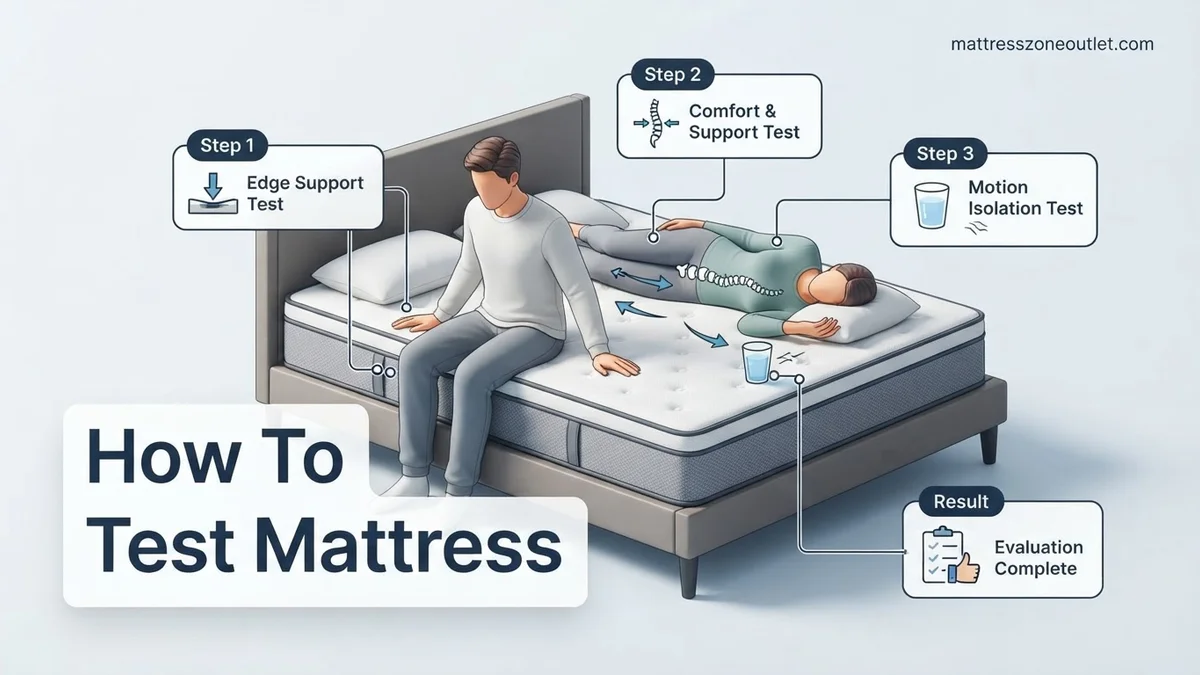
Step 3: Evaluate Edge Support and Perimeter Stability
What you need: Just your body weight and the edge of the mattress.
Instructions: Sit directly on the very edge of the mattress, simulating how you sit when putting on your shoes in the morning. Notice if the perimeter completely collapses under your weight, making you feel like you are sliding off. Next, lie down close to the outer edge of the bed. You should feel secure and supported without any sensation of rolling off the side. Good edge support is crucial because it effectively increases your usable sleeping surface and prevents premature sagging.
Pro Tip: Mattresses with reinforced perimeters or high-density foam encasements generally offer superior edge support, which is especially important for couples sharing a smaller bed.
Step 4: Test Motion Isolation for Undisturbed Sleep
What you need: A glass of water or a willing partner to share the testing bed.
Instructions: If you sleep with a partner, pet, or restless child, motion isolation is a critical feature to check. If you are testing in a store with a partner, have them toss, turn, and get in and out of bed while you lie still on the opposite side. If you are testing alone, place a full cup of water near the center of the mattress, then press down, shift your weight, or drop onto the bed a couple of feet away. Observe how much the water ripples or if the cup tips over.
Pro Tip: All-foam and memory foam mattresses typically offer the highest degree of motion isolation, while traditional innerspring beds tend to transfer more bounce across the surface.
Step 5: Assess Temperature Regulation and Airflow
What you need: At least 15 to 20 minutes of continuous lying time to allow body heat to accumulate.
Instructions: Many modern memory foam mattresses tend to trap body heat, leading to uncomfortable night sweats. As you lie on the mattress during your extended test, monitor whether heat begins building up underneath your body. If you feel yourself overheating within a short timeframe, look for alternative models featuring open-cell foams, copper infusions, gel layers, or traditional pocketed coils that promote maximum internal airflow.
Pro Tip: Always factor in your bedroom climate and the type of bedding you use, as heavy duvets can make even a cooling mattress feel warm.
Step 6: Measure Responsiveness and Ease of Movement
What you need: Your own body mechanics and a willingness to move dynamically.
Instructions: Try changing positions rapidly from your back to your side, or practice getting out of bed quickly. Some high-density memory foams create a “quicksand” effect that makes shifting positions difficult and physically exhausting. A great mattress should respond quickly to your movements, allowing you to transition smoothly without feeling stuck or requiring excessive muscular effort.
Pro Tip: Hybrid mattresses—which combine pocketed coils with latex or responsive comfort foams—often provide the ideal balance of contouring pressure relief and easy bounce-back responsiveness.
Step 7: Conduct a Long-Term At-Home Sleep Trial
What you need: A mattress purchased from a retailer offering a minimum 30-to-100-night sleep trial, plus your standard sheets and pillows.
Instructions: Showroom tests are only the first phase. Once you bring the mattress home, sleep on it for at least 30 consecutive nights. Your body needs a proper adjustment period—often two to four weeks—to adapt to a new support system, especially if your old mattress was heavily sagging. Keep detailed mental or written notes on whether your morning back stiffness improves, how easily you fall asleep, and how refreshed you feel upon waking.
Pro Tip: Ensure you check the retailer’s return policy details, including whether return shipping fees apply and if you are required to keep the bed for a mandatory break-in period.
✅ Final Checklist
- Tested all primary sleeping positions for at least 5-10 minutes each
- Verified that the spine maintains a neutral, straight alignment without hip sagging
- Evaluated edge support by sitting and lying near the perimeter
- Checked motion transfer using a partner or the water glass test
- Assessed temperature regulation during an extended resting period
- Confirmed sleep trial terms and warranty conditions for at-home purchases
Important Notes:
- Always use a supportive, compatible foundation or bed frame, as an improper base can void your mattress warranty and compromise support.
- Consult a physical therapist or orthopedic specialist if you suffer from chronic back pain, as you may require a specific firmness level prescribed for your condition.
- Estimated time: 30 minutes for showroom testing, or 30 to 100 days for a complete at-home sleep trial; Cost range: Varies widely from $500 to $3,000+ depending on materials and brand.
How to Test a Mattress in a Showroom Step-by-Step
The 15-Minute Rule
When you find a promising model, clear your schedule and commit to lying on it for a full 15 to 20 minutes. Spend the first five minutes on your back, shift to your side for another seven minutes, and finish on your stomach if that is how you sleep. Pay attention to how your muscles react after the initial ten-minute mark. If your lower back starts to tense up or your shoulders begin to go numb, the comfort layers are failing to properly contour to your body.
Assessing Edge Support and Isolation
Do not just lie in the middle of the display bed. Sit directly on the edge to see if the perimeter collapses or supports your weight evenly, which is crucial if you sleep near the side or put on shoes in the morning. If you share a bed, test motion transfer by having your partner toss and turn while you lie still.
- Check for excessive sinkage when sitting on the corners.
- Look for rolling-together tendencies in the center.
- Test how quickly the foam recovers its shape after you move.
How to Maximize an At-Home Sleep Trial
Most mattress brands offer a sleep trial ranging from 100 to 365 nights. According to clinical sleep studies from the Journal of Clinical Sleep Medicine, the human body requires approximately 30 days to adjust to a new support surface. Rushing this adjustment period often leads to premature returns.
To ensure an accurate evaluation of your mattress during 2026, follow this strategic testing protocol:
- Complete the 30-day break-in period: Commit to sleeping on the mattress for at least four weeks before initiating a return. Foam layers need time to soften slightly, and your musculoskeletal system requires time to adapt.
- Keep the protective cover on: Manufacturers strictly enforce return policies regarding hygiene. Always use a waterproof, breathable mattress protector to void any damage claims.
- Test in your natural sleeping positions: Spend adequate consecutive nights sleeping on your back, side, and stomach. Note any morning stiffness, lower back aches, or numbness in your shoulders.
- Evaluate temperature regulation: Assess how the mattress manages body heat across different seasonal ambient temperatures. Modern phase-change materials should actively dissipate heat throughout the night.
What If It Still Doesn’t Work?
If you have completed the full adjustment period and still wake up fatigued or in pain, the mattress is likely incompatible with your biomechanical profile. Do not force yourself to keep an unsupportive bed, as chronic spinal misalignment can worsen joint degradation.
Execute these fallback steps if your trial period is failing:
- Initiate the return or exchange process: Contact customer support before your trial window closes. Most online-exclusive brands coordinate free home pickup and full refunds.
- Adjust the firmness with a topper: If the mattress is merely too firm, add a 2-to-3-inch latex or memory foam topper. Quality toppers range from $150 to $350.
- Inspect your foundation: Ensure your bed frame or box spring is not sagging. A compromised base mimics a defective mattress.
- Consult a physical therapist or chiropractor: If sleep-related back pain persists across multiple sleep surfaces, seek professional medical evaluation to rule out underlying structural spinal issues.
Conclusion
Testing a mattress requires a systematic approach that balances immediate physical comfort with long-term spinal support. Rushing the decision often leads to chronic discomfort and wasted investments. According to verified research and sleep medicine experts, taking advantage of structured at-home trials ensures your final choice promotes optimal spinal alignment and deep restorative sleep. Your actionable next step for 2026 is to measure your bedroom space, define your primary sleeping position, and select a model that offers at least a 100-night risk-free trial.
❓ Frequently Asked Questions
What are the most important metrics to evaluate when testing a mattress?
The primary metrics to evaluate are spinal support, pressure point relief, firmness level, motion isolation, and temperature regulation. Each of these directly impacts your overall sleep quality and physical comfort.
How can I test a mattress for motion transfer with a partner?
If testing in-store, have your partner move around or get in and out of bed while you lie still. During an at-home trial, you can place a glass of water on the mattress and watch how much it ripples when your partner moves.
Why does a mattress feel different at home compared to the showroom?
Showrooms often use ambient lighting, different room temperatures, and temporary flooring that alters how a bed feels. Additionally, brand-new mattresses require a break-in period of a few weeks to soften to their true feel.
How long is the typical break-in period for a new mattress?
A new mattress generally requires 30 days for the internal foam or coils to adjust to your body weight and for your muscles to adapt to the new support surface.
What should I wear when going out to test mattresses?
Wear loose, comfortable clothing and supportive footwear that is easy to slip off so you can comfortably lie down on multiple beds without restriction.
What are the red flags to avoid when evaluating a mattress?
Avoid mattresses that cause your hips to sink too deeply, create pressure points in your shoulders or lower back, or lack adequate perimeter support when you sit on the edge.