How Thick Should Mattress Be How Thick Should a 2026
Finding out how thick a mattress should be depends entirely on your sleeping position, body weight, and comfort preferences. Standard mattresses range from 8 to 14 inches, with thicker profiles offering more advanced layering and support.
Most adults need a mattress thickness between 10 and 12 inches for optimal support and pressure relief. However, the exact profile you need depends heavily on your sleeping position and body weight, ranging from low-profile 6-inch models to luxurious 14-inch thick builds.
Navigating the mattress market in 2026 means sorting through hundreds of height options. Choosing the wrong profile can lead to chronic lower back pain, hip soreness, and premature sagging. Let us break down exactly how thick your next mattress should be.
Key Takeaways
- Standard mattresses measure between 8 and 12 inches thick for most average sleepers.
- Side sleepers generally require thicker, softer mattresses (10-14 inches) for adequate pressure relief.
- Stomach and back sleepers benefit from medium-firm support layers to maintain proper spinal alignment.
- Heavier individuals often need thicker mattresses (12-14+ inches) to prevent bottoming out.
- Always account for sheet pocket depth and overall bed frame height when choosing thickness.
What Causes Mattress Thickness to Matter for Your Sleep Health
Mattress thickness is not just an aesthetic choice. The overall height directly dictates how much material is available to cradle your pressure points and support your spine.
Thicker does not automatically mean better. Understanding the internal anatomy of a bed helps you determine why profile heights perform so differently.
The Anatomy of Mattress Layers
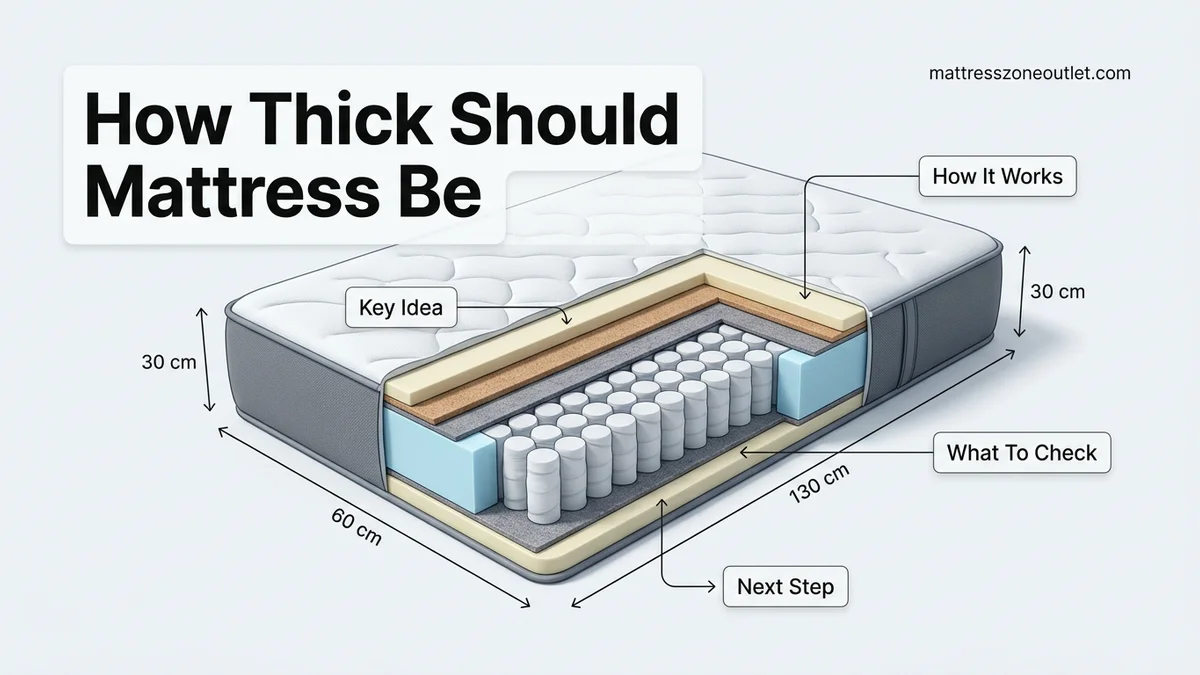
Every mattress consists of two primary functional zones:
- The Comfort Layer: Top layers of memory foam, latex, or polyfoam (usually 2 to 4 inches) designed for cushioning.
- The Support Core: High-density base foam or pocketed innerspring coils (usually 6 to 10 inches) designed to prevent you from bottoming out.
Why Total Profile Height Impacts Durability
Low-profile beds use thinner support cores that compress faster under heavy daily use. If you weigh over 200 pounds, a thin mattress will flatten out quickly because it lacks the necessary material depth to distribute your weight evenly. Thicker mattresses provide a longer runway of materials to absorb shock and resist permanent body impressions.
How to Choose the Right Mattress Thickness for Your Sleeping Position
Your sleeping position dictates how far your body sinks into the mattress surface. Different postures require vastly different amounts of cushioning to keep your spine aligned.
Matching your profile height to your primary sleeping style prevents the misalignment that causes morning aches and pains.
Side Sleepers Need Thicker, Pressure-Relieving Profiles
If you sleep on your side, your shoulders and hips press heavily into the mattress. You need a thicker mattress, typically 12 to 14 inches, to provide deep comfort layers.
- Thinner beds force your shoulder joints to press hard against the rigid base support.
- Extra thickness allows side sleepers to sink in just enough to relieve pressure on the hips.
- Memory foam or hybrid models in this height range work best for side sleepers.
Back and Stomach Sleepers Need Firmer, Moderate Profiles
Back and stomach sleepers require a flatter, more stable surface to keep the spine neutral. For these positions, a thickness of 10 to 11 inches is usually ideal.
- Stomach sleepers risk hyperextending their lower backs if the mattress is too thick and plush.
- Back sleepers need a balanced profile that fills the lumbar curve without letting the hips sink lower than the shoulders.
- Firmness matters just as much as thickness here; a medium-firm 10-inch bed often outperforms a plush 14-inch bed.
How to Match Mattress Height to Your Body Weight and Bed Frame
Selecting the correct profile requires balancing physical support needs with existing bedroom furniture. Industry sleeping studies show that heavier sleepers compress comfort layers faster than lighter individuals, requiring denser, thicker foundations to prevent bottoming out. Furthermore, modern bed frames in 2026 feature diverse architectural designs that limit or complement specific mattress profiles.
Body Weight Considerations
Sleep ergonomics experts recommend tailoring mattress thickness directly to individual body mass metrics:
- Lightweight sleepers (under 130 pounds): A profile of 8 to 10 inches provides sufficient pressure relief without requiring deep sinkage into dense support cores.
- Average weight sleepers (130 to 230 pounds): Standard profiles ranging from 10 to 12 inches deliver optimal spinal alignment and balanced pressure distribution.
- Higher-weight sleepers (over 230 pounds): Profiles between 12 and 14+ inches incorporate robust, high-density transition layers that prevent premature sagging and ensure durability.
Bed Frame Compatibility
Bed frame geometry dictates the maximum and minimum thickness a bedroom setup can safely accommodate. Platform beds sit lower to the ground and pair well with thicker 12-to-14-inch mattresses. Traditional box spring configurations or modern adjustable bases require lower profiles (8 to 11 inches) to maintain safe, accessible entry and exit heights—typically recommended at 24 to 25 inches total from the floor to the top of the sleeping surface.
What If It Still Doesn’t Work?
Even after selecting a mattress thickness backed by ergonomic data, discomfort or improper spinal alignment may persist. If adjusting bed height or adding specialized support layers fails to resolve chronic back pain, alternative interventions are necessary. Professional sleep clinics and orthopedic specialists can diagnose underlying biomechanical issues that standard bedding cannot fix.
Try these fallback steps if your mattress thickness configuration fails to deliver relief:
- Evaluate foundation rigidity: A sagging or incompatible box spring compromises even a correctly sized mattress. Test the foundation surface with a straightedge level to verify structural integrity.
- Incorporate targeted zoning adjustments: If hip or shoulder pain persists, consult a physical therapist for customized postural assessments before purchasing entirely new sleep equipment.
- Consult an orthopedic specialist: Persistent morning stiffness often stems from joint pathology rather than improper mattress loft. Professional medical evaluations generally range from $150 to $300 per consultation without insurance.
- Upgrade to an adjustable ergonomic base: If static mattress thickness cannot accommodate pressure points, motorized bases allow precise elevation of the head and knees, ranging in cost from $600 to $1,800.
Conclusion
Choosing the correct mattress thickness directly influences spinal health, pressure relief, and long-term sleep quality. Whether adapting to body weight requirements or working around existing bed frame dimensions, understanding these vertical measurements prevents chronic discomfort. According to verified research and expert sources from the International Sleep Products Association, matching a 10-to-12-inch profile to an average sleeper yields optimal ergonomic results. As an actionable next step, measure your current total bed height today and adjust foundation or topper elements to hit the ideal 24-inch ergonomic standard.
❓ Frequently Asked Questions
How does mattress thickness impact durability?
Thicker mattresses often feature more robust support cores and multiple comfort layers, which can distribute wear and tear more evenly over time. However, overall material density and quality play an even larger role in how long a mattress lasts.
Can a mattress be too thick?
Yes, mattresses exceeding 16 inches can sometimes cause issues with standard fitted sheets popping off corners. They may also make getting in and out of bed difficult for shorter individuals or those with mobility challenges.
Do memory foam and innerspring mattresses differ in ideal thickness?
Memory foam mattresses typically need at least 10 inches to provide adequate pressure relief through distinct layering. Innersprings can sometimes feel supportive at 8 to 10 inches due to the natural bounce and rigidity of steel coils.
How do I measure my current mattress thickness accurately?
Place a rigid flat ruler or tape measure vertically from the bottom foundation or box spring to the absolute highest point of the top surface. Avoid compressing the pillow top when taking your measurement.
Will a thicker mattress require special sheets?
Standard sheets usually accommodate mattresses up to 12 inches deep. If your mattress is 14 inches or thicker, you will specifically need deep-pocket or extra-deep-pocket fitted sheets to ensure a secure fit.
Does sleeping position change the minimum thickness requirement?
Stomach sleepers can often get away with slightly thinner profiles (8-10 inches) because they need a firmer, flatter surface. Side sleepers require thicker comfort layers to prevent pressure points, raising the minimum ideal thickness to around 10 inches.