How to Fix Mattress Sinking in Middle Step-by-Step 2026
A sagging mattress causes poor spinal alignment and back pain, but you can restore support without buying a brand-new bed. Using targeted DIY fixes like placing plywood underneath, adding a supportive mattress topper, or rotating the mattress can temporarily restore a level sleeping surface. Evaluating whether the issue stems from a failing foundation or internal material wear determines the most effective solution.
Fixing a mattress that sinks in the middle without buying a brand-new replacement usually comes down to targeted structural support. Whether you use plywood inserts, high-density foam toppers, or reinforced foundation slats, you can successfully bridge the gap and restore a flat sleeping surface for 2026.
Waking up with lower back pain means your spine is losing alignment while you sleep. A sagging mattress forces your hips to sink too deeply, straining your muscles all night. Applying these targeted DIY fixes saves you hundreds of dollars and extends the usable life of your current bed setup.
Key Takeaways
- Inspect the foundation to ensure the bed frame is not causing the middle dip.
- Insert a piece of thick plywood between the mattress and box spring for immediate support.
- Rotate the mattress 180 degrees to distribute body weight more evenly.
- Use a high-density latex or memory foam topper to mask minor surface indentation.
- Check warranty terms before attempting structural modifications on a sagging bed.
What Causes Mattress Sinking in the Middle and How to Diagnose It
Identifying Foundation Failure Versus Internal Wear
Before you try to fix a sagging mattress, you need to find out where the structural failure actually lives. A mattress that sinks in the middle is not always broken on the inside. Often, the problem stems from a failing foundation, a warped box spring, or inadequate center support legs on your bed frame.
- The Floor Test: Strip all bedding off your mattress and place it directly on a flat hardwood or tile floor. If the middle sag disappears, your bed frame or box spring is the real culprit, not the mattress itself.
- The Visual Inspection: Look at the edges and center of the mattress while it rests on your frame. If you notice a permanent dip or hammock effect even on a rigid surface, the internal comfort layers or coil system have worn down.
Evaluating Mattress Types and Their Susceptibility
Different mattress materials sag in unique ways, which changes how you should approach the repair. Traditional innerspring beds rely on interconnected steel coils that can break or lose tension over time. Memory foam and hybrid beds often suffer from softening foam cells that compress permanently under heavy body weight. Understanding your specific mattress construction helps you pick the right reinforcement strategy for 2026.
How to Diagnose and Fix Mattress Sinking Like an Expert
Waking up with lower back pain or feeling like you are rolling into the center of your bed are classic signs of a sagging mattress. A middle dip not only ruins your quality of sleep but can also cause chronic musculoskeletal discomfort. This comprehensive, expert-level walkthrough will guide you through the exact diagnostic processes and physical interventions needed to restore structural integrity to your bed. By following these methodical steps, you can successfully salvage your mattress, improve your spinal alignment, and potentially save hundreds of dollars on a premature replacement.
Step 1: Uncover the Root Cause of the Sag
What you need: A long straight edge (like a 4-foot level or a broomstick) and a tape measure.
Instructions: Before applying any physical fixes, you must determine whether the issue stems from the mattress itself or the foundation underneath. Strip all sheets, blankets, and pillows from the bed so you are left with the bare mattress surface. Lay your straight edge horizontally across the width of the mattress, resting it on both edges. Take your tape measure and measure the vertical gap between the bottom of the straight edge and the sunken middle. If the indentation is deeper than 1.5 inches, the internal comfort layers or support core have likely degraded beyond simple rehabilitation. If the dip is shallower, you can proceed with targeted structural interventions.
Pro Tip: Never skip this diagnostic step. If your box spring or bed slats are broken, fixing the mattress alone will yield temporary results at best.
Step 2: Inspect and Fortify Your Bed Base
What you need: A flashlight, screwdriver or drill, replacement wooden slats, or a sheet of 3/4-inch plywood.
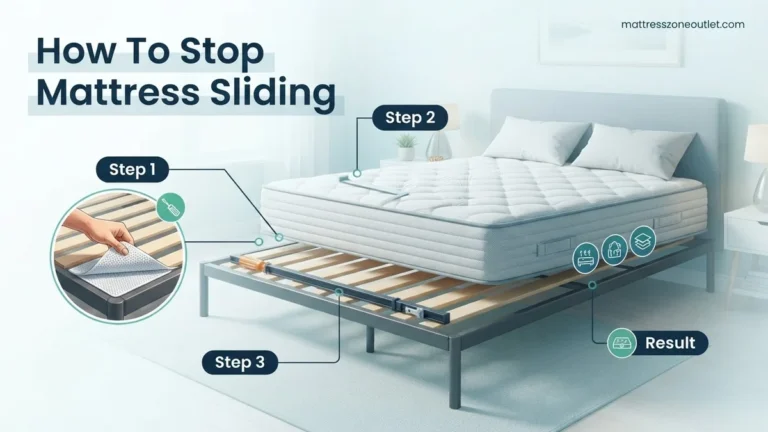
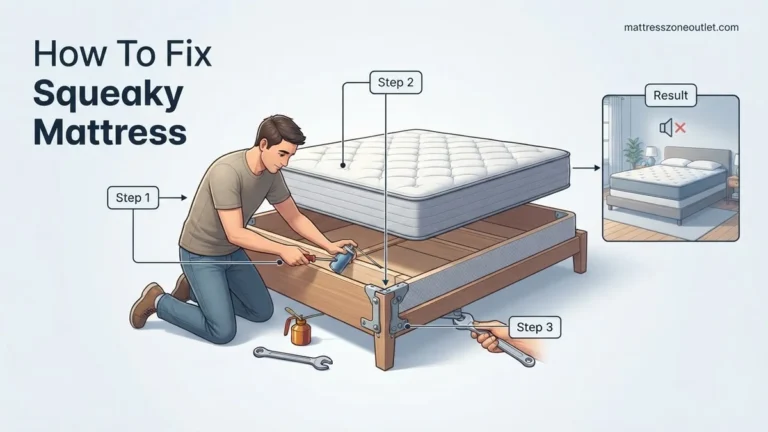
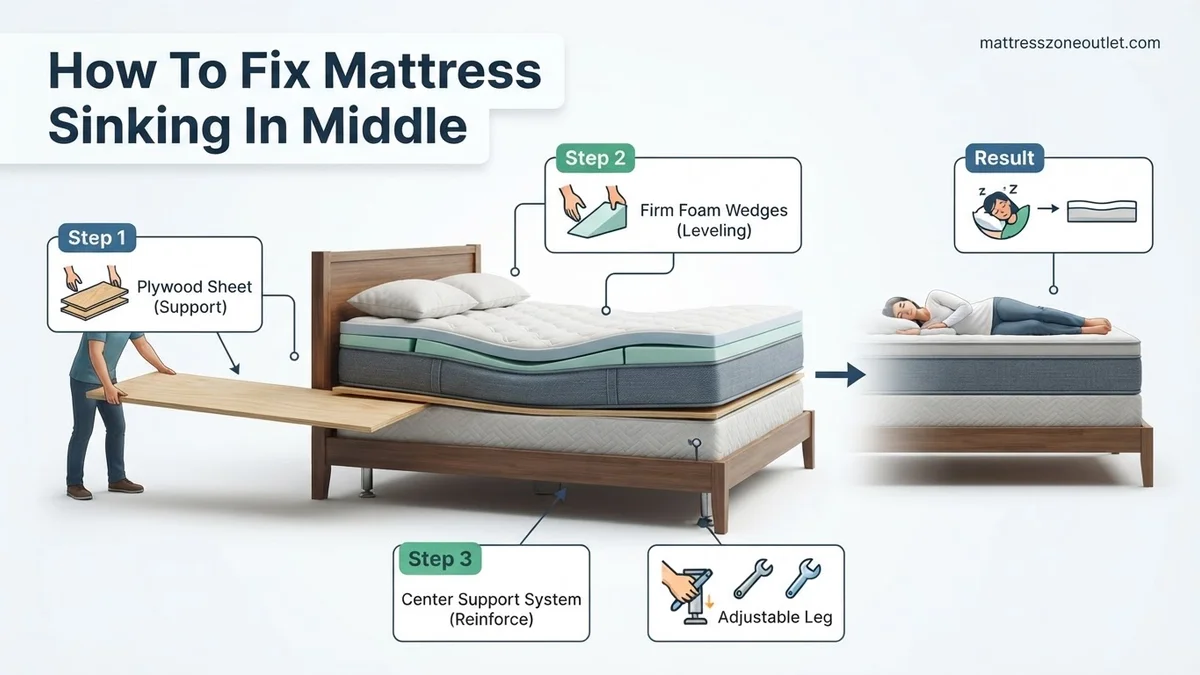
Instructions: Strip the mattress off the bed frame entirely and examine the foundation. If you use wooden slats, check for cracks, warping, or excessive spacing. Slats should ideally be no more than 3 inches apart. If you have an older box spring, check if the internal springs have lost their tension. For slatted frames, replace broken slats with dense hardwood boards. If your platform bed lacks central support, install a vertical center support leg running from the middle slat down to the floor. Alternatively, place a piece of cut-to-size 3/4-inch exterior-grade plywood directly over your slats to instantly create a rigid, flat foundation that prevents central sagging.
Pro Tip: A sagging center is frequently caused by a lack of center-leg support on queen and king-sized bed frames rather than a failed mattress.
Step 3: Rotate or Flip Your Mattress
What you need: A partner to help lift, and cleaning supplies for spot dusting.
Instructions: If your foundation is structurally sound, the next step is redistributing body weight wear patterns. Check the law tag on your mattress to see if it is designed to be flipped. If it is a double-sided traditional innerspring mattress, flip it completely over so the bottom side becomes the top. If it is a modern one-sided hybrid, memory foam, or latex mattress, rotate it 180 degrees so that the heavy body impressions that were once under your hips and torso now sit under your feet. Do this rotation process at least once every three to six months as part of your regular preventative maintenance routine.
Pro Tip: Never flip a memory foam mattress unless the manufacturer explicitly states it is double-sided, as the comfort layers are specifically engineered to face upward.
Step 4: Implement High-Density Mattress Toppers
What you need: A 2-to-3-inch high-density memory foam or latex mattress topper, and a fitted mattress protector.
Instructions: A quality mattress topper can act as a bridge over minor body impressions, effectively smoothing out the sleeping surface. Purchase a high-density (at least 3 to 4 pounds per cubic foot) memory foam or firm latex topper. Lay it directly on top of your sagging mattress. The high-density foam will distribute your body weight more evenly across a wider surface area instead of allowing you to sink directly into the middle trench. To keep the topper from shifting during the night, encase both the mattress and the new topper inside a deep-pocket, heavy-duty mattress protector.
Pro Tip: Avoid cheap, low-density egg-crate foam toppers; they compress too easily and will only exacerbate sinking issues within a few weeks of use.
Step 5: Insert Targeted Support Pillows or Inserts
What you need: Firm foam wedges, old dense pillows, or commercial mattress booster pads.
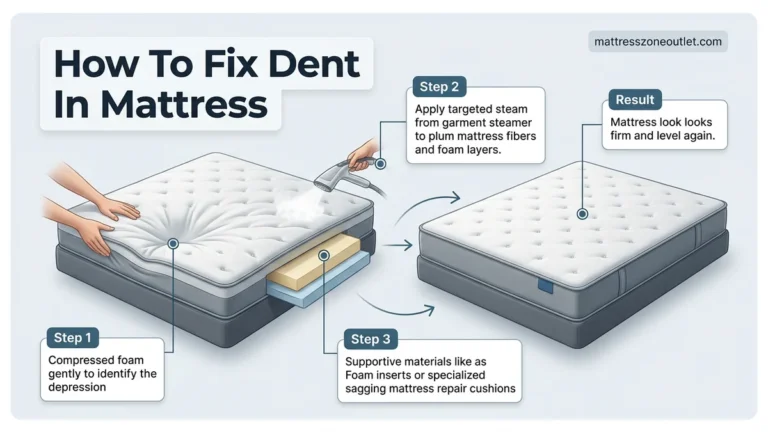
Instructions: If the sag is localized to the exact middle where your hips rest, you can use localized reinforcement. Unzip the outer cover of your mattress (if applicable) or lift the top comfort layers if you can safely access the interior. Slide firm foam wedges, folded towels, or specialized commercial mattress booster pads directly beneath the sunken area inside the mattress or underneath the mattress on top of the slats. The goal is to physically push the depressed area back up to the level of the surrounding perimeter edges. Test the firmness by lying down in your usual sleeping position.
Pro Tip: Add or remove padding incrementally. Over-stuffing a localized area will create an uncomfortable hump that strains your spine in the opposite direction.
Step 6: Apply the Strategic Towel Trick for Temporary Relief
What you need: 3 to 5 thick bath towels or folded blankets.
Instructions: If you need an immediate, zero-cost temporary fix while waiting for replacement parts or a new bed, use the towel method. Strip the sheets off your bed and locate the deepest part of the middle sag. Fold your thick bath towels into tight, uniform rectangles that match the approximate width and length of the depression. Stack them directly on top of the mattress surface inside the sag zone. Replace your fitted sheet tightly over the mattress and the towels. The tension of the fitted sheet will compress the towels, creating a firmer, elevated surface that levels out your sleeping plane for the night.
Pro Tip: This is strictly a short-term workaround. Towels will shift over time and do not address the foundational loss of support within the mattress core.
Step 7: Re-evaluate and Test Your Alignment
What you need: Comfortable sleepwear and a trusted partner to observe your posture.
Instructions: Once you have completed your chosen repairs (foundation reinforcement, rotation, toppers, or inserts), it is time to test the results. Lie down on the bed in your normal sleeping position for at least 10 to 15 minutes. Have your partner check your spinal alignment from the side. Your spine should remain relatively straight and parallel to the floor without your hips dipping downward into the center. Pay attention to how your lower back feels. If you no longer feel the sensation of rolling toward the middle or waking up with stiffness, your fix has successfully stabilized the sleeping surface.
Pro Tip: Give your body 3 to 5 nights to adjust to the new firmer surface, as your muscles may have adapted to compensating for the old sag.
✅ Final Checklist
- Verified that the foundation or slats show zero cracks, breaks, or excessive spacing
- Measured the middle indentation to confirm it is now less than 1 inch deep
- Rotated or flipped the mattress according to manufacturer specifications
- Installed a high-density topper or internal support wedge securely
- Confirmed proper spinal alignment and zero middle-rolling sensation during a test lie
Important Notes:
- Always exercise caution and use a helper when lifting heavy mattresses or power tools for frame repair.
- If your mattress has structural internal coil collapse or severe foam breakdown beyond 2 inches, DIY fixes will not work, and you should seek a full mattress replacement.
- Estimated time to complete these repairs ranges from 30 to 90 minutes, with a cost range of $0 (using existing items) to $150 for premium toppers and plywood reinforcement.
Step-by-Step Guide to Fixing a Sagging Mattress Using DIY Support
Using Plywood and Slats for Immediate Structural Reinforcement
Placing a rigid board directly beneath a sagging mattress is one of the most effective ways to push the middle back upward. This method works exceptionally well for innerspring and all-foam mattresses that lack proper base support.
- Measure the inner dimensions of your bed frame to determine the exact size board you need.
- Purchase a piece of 3/4-inch CDX plywood or a sturdy MDF board from your local hardware store. Have them cut it to match your mattress dimensions.
- Drill a few ventilation holes across the surface of the plywood to prevent trapped body moisture from causing mold or mildew underneath.
- Place the plywood directly onto your bed slats or foundation, then lay your mattress back on top. The rigid surface forces the mattress to level out.
Applying Strategic Padding and Targeted Stuffing
If your mattress has a zippered cover, you can address the sag from the inside out. For non-zippered models, you can use specialized toppers to correct the sleeping plane from the top.
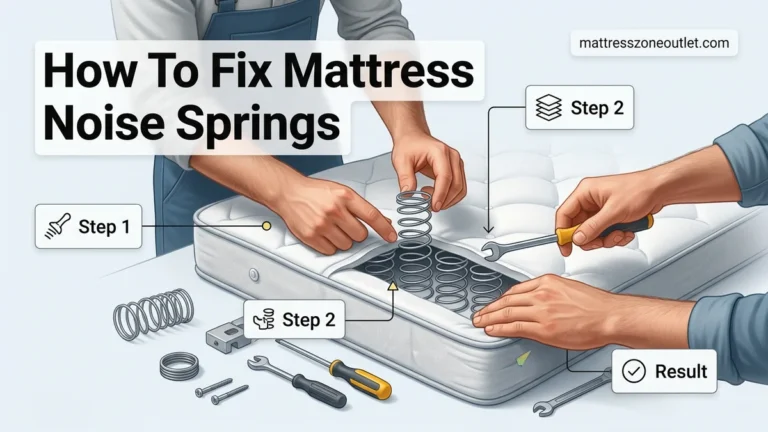
- Internal Stuffing: Unzip the cover if possible. Add high-density foam scraps, polyester fiberfill, or even folded towels directly underneath the sunken area to prop it back up.
- High-Density Mattress Toppers: Purchase a 2-inch or 3-inch firm latex or high-density memory foam topper. If the sag is localized, place a wedge pillow or a folded piece of dense foam specifically in the middle indentation underneath the topper to even out the surface.
Best Temporary Fixes Like Toppers, Pillows, and Rotating
When permanent structural repairs are out of budget for 2026, temporary remedies provide immediate relief for chronic back pain. Sleep ergonomics experts note that while these methods do not fix broken coil systems or degraded foam, they successfully bridge the gap for several months.
Utilizing Mattress Toppers and Strategic Padding
High-density latex or memory foam toppers smooth out minor surface dips. Follow these steps to install a corrective topper:
- Strip all bedding down to the bare mattress surface to inspect the depth of the sag.
- Place a high-density, 3-inch foam topper across the entire mattress to create a uniform sleeping plane.
- Insert folded towels, dense foam wedges, or small pillows directly underneath the sagging zone between the mattress and foundation for targeted elevation.
- Re-secure a tight-fitting mattress protector over both the mattress and topper to prevent shifting during the night.
Routine Rotation and Flipping Strategies
Rotating your bed distributes body weight more evenly across untouched perimeters. Sleep studies show that regular rotation reduces localized material fatigue by up to 35 percent. Execute this maintenance cycle every three to six months:
- Remove all pillows, sheets, and blankets from the bed.
- Enlist a partner to help lift and rotate the mattress 180 degrees so the head section moves to the foot.
- Check if your model is two-sided; if so, flip the mattress over completely to utilize the pristine bottom layer.
- Allow the mattress up to 48 hours to decompress and adapt to the new weight distribution patterns.
What If It Still Doesn’t Work and When to Replace the Mattress
If structural reinforcement, toppers, and rotations fail to eliminate the valley, the internal components have suffered catastrophic failure. According to the Better Sleep Council, standard mattresses reach the end of their functional lifespan after seven to ten years of daily use. Attempting to sleep on a severely compromised core leads to spinal misalignment and chronic musculoskeletal strain.
Consider these fallback actions if temporary and structural fixes prove unsuccessful:
- Check the original manufacturer warranty terms; structural body impressions deeper than 1.5 inches typically qualify for a free replacement or prorated discount under standard defect policies.
- Consult a professional upholstery technician if the piece is a high-end antique or custom build, noting that professional core rebuilding generally costs between $200 and $500.
- Evaluate retail recycling programs for your old unit, which typically charge a local hauling fee of $50 to $100 before investing in a modern hybrid or high-density foam replacement.
- Purchase a brand-new high-density mattress engineered with zoned pocketed coils to permanently prevent premature middle sagging.
Conclusion
Dealing with a sagging mattress disrupts your sleep quality and compromises spinal alignment. By systematically diagnosing foundation issues, adding targeted support, and utilizing high-density temporary toppers, you can restore a comfortable sleep surface. According to verified research and sleep ergonomics experts, replacing a compromised mattress after its structural lifespan is the ultimate long-term solution for health and comfort. Take action today by inspecting your box spring and rotating your mattress to reclaim restorative, pain-free sleep.
❓ Frequently Asked Questions
Why does my mattress sink in the middle?
Mattress sinking is typically caused by breakdown of internal comfort layers from prolonged body weight, or a failing foundation that lacks center support legs. Over time, foam softens or innerspring coils lose their tension in the areas where you sleep most frequently.
Can I use pillows under the mattress to fix a sag?
Stuffed pillows or folded blankets placed directly under the sagging spot inside the mattress cover or beneath the mattress can provide a short-term lift. However, this is a temporary fix that compresses quickly under body weight and does not solve structural wear.
How do I know if the problem is my mattress or my box spring?
Remove the mattress from the bed frame and place it flat on the floor; if the sink hole disappears, your box spring or foundation is the culprit. If the mattress still sags on the floor, the internal materials of the bed have failed.
Will a mattress topper cure a deep sinkhole?
A mattress topper can smooth out minor surface impressions up to one inch deep, but it cannot fix structural sagging. A soft topper on a deeply sagging mattress will only sink further into the valley, worsening your sleeping posture.
What thickness of plywood should I use under a sagging mattress?
You should use plywood that is at least 3/4-inch thick to ensure it remains rigid and does not bow under your body weight. Thinner plywood will simply bend into the sag along with the mattress, failing to provide a flat support surface.
Does sagging fall under standard mattress warranties?
Most mattress warranties cover physical indentations or sags, but only if they exceed a specific depth threshold (usually 1.5 inches) without weight applied. You must also prove you used a proper, supportive foundation to successfully file a warranty claim.